Most of the work in optimization happens before any solver runs: reading a story and turning it into a model. There are always the same four steps. Name what you decide, say what you want, list what limits you, and check the result against the story.
1. Decisions. Give each quantity you control a symbol and a unit, for example b = loaves of bread baked and c = cakes baked per day. In words: if you cannot say what a variable measures, it is not ready.
2. Objective. Write the thing to maximise or minimise as a formula in the decisions: \text{profit} = 4b + 5c . In words: every loaf earns 4 and every cake 5; the formula adds up the money.
3. Constraints. One inequality per limited resource, in the same units on both sides: 2b + 3c \le 24 \;\;(\text{oven hours}),\qquad 3b + 2c \le 26 \;\;(\text{kg of flour}),\qquad b, c \ge 0 . In words: a loaf uses 2 oven hours and 3 kg of flour, a cake 3 oven hours and 2 kg; the oven has 24 hours and the pantry 26 kg; you cannot bake a negative amount.
4. Check. Put the answer back into the story. Are all limits respected? Is a limit you did not mention (for example whole loaves only) missing from the model?
The story above, written in ProvenDecisions syntax:
maximize 4 b + 5 c
subject to
2 b + 3 c <= 24
3 b + 2 c <= 26
b, c >= 0
# b = loaves of bread per day, c = cakes per day
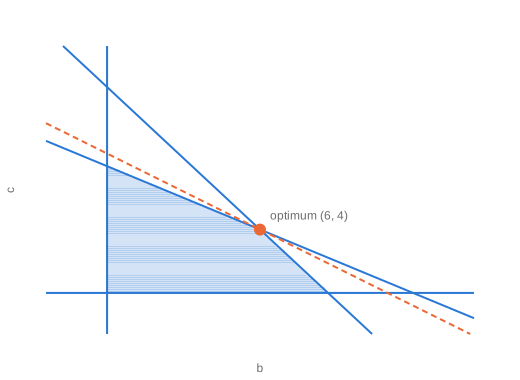
Bake 6 loaves and 4 cakes for a profit of 44 (status optimal). The picture shows the two limit lines meeting at the answer.
A new customer wants at least 2 cakes a day, but the oven is down to 20 hours. Edit the model and solve it:
maximize 4 b + 5 c
subject to
2 b + 3 c <= 20
3 b + 2 c <= 26
c >= 2
b, c >= 0
# same story, tighter oven, a minimum order
The profit becomes 38 with 7 loaves and 2 cakes. Practise on the paint-mix and diet problems in the library (the golden problems listed above).